Unlock the secret world beneath the mexican jungle
“Cenote” comes from the Mayan word dzonot, which means “water eye.” Although they sometimes look like natural pools or small lakes, they’re actually gates to the world’s largest networks of subterranean rivers, which the Mayan knew as Xibalba.
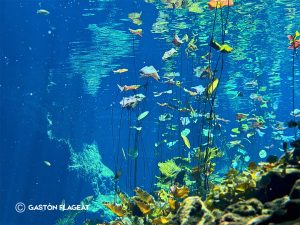
Come explore México’s cenotes with us and discover this unique underwater ecosystem, home to wondrous geological formations, mystical haloclines and sulfur clouds, and ice age fossils. After an adventurous ride into the jungle, you will be welcomed by crystal-clear freshwater and magnificent plays of lights and shadows. We work with the most experienced cave divers to offer you cenote dives that you will remember for a lifetime.
More than 12,000 years ago the landscape of the peninsula was very similar to the current African grasslands.
Ancient settlers used to refuge in caves, where they also collected water and buried their dead. At the end of the Ice Age, sea levels rose flooding these caves. Also the vegetation gradually changed to what we know today and cenotes were the only source of fresh water in the region.
Since then, humans had a close relationship with cenotes, being decisive for the development of Mayan civilization in these lands. In their cosmogony, caves and cenotes were symbolic spaces for rituals of rain, life, death, rebirth and fertility.
Culturally cenotes represent entrances to the underworld, called Xibalbá; environmentally they are the support of life since they are the only source of fresh water in the region. Hence the importance of conserving these worlds that hide countless secrets.
Quintana Roo shares the Yucatan Peninsula physical characteristics that makes it a very peculiar terrain, geologists call it karst; consisting of limestone which has been dissolved relatively easily under rainwater action.
The sedimentary platform on which the Peninsula is located is geologically known as the “Mayan Block”, a shallow water seabed formed by calcareous deposits, mainly of coral skeletons.
This sea botton was exposed to the surface by climate changes over thousands of years. Filtered rain, along with organic acids, formed the vast underground caves and thousands of cenotes.
Slow dissolution of karst over thousands of years has turn the peninsular ground in a bed full of grottos, caves and caverns, which in Mayan are known generally as aktún, from the root ak, which means hollow or empty, and tun stone.
This rainwater infiltration and rock dissolution have determined the hydrological characteristics of the Peninsula and the physical properties of water in the region.
Because of the karstic characteristics of the Yucatan Peninsula this region has no rivers in sight, however, underground water pools have formed a great river network that runs to the east, north and south of the peninsula leading infiltrated rainwater to the sea.
Rainwater filtration over thousands of years through the cracks in the limestone floor, has gradually formed large underground water pools and caverns. Finally, the cavern roof collapses because of water filtration, exposing the water pool or cenote.
Depending on their shape and according to the stage of opening that connects the underground aquifer with the forest and sunlight on the surface, they are classified as: Jar form, Vertical walls, Watery form, Cavern form
Although Mayan people today still hold the cenotes as a place to worship, its value has been associated with tourism.
The now called Riviera Maya of Quintana Roo, with its white sand beaches, countless reef barriers and mysterious cenotes, represents one of the fastest growing areas in the country.
Undoubtedly, tourism brings economic benefits to the region, but also carries a risk of not only destroying the cenotes and groundwater, but also the natural and cultural heritage.
Groundwater systems are extremely fragile and their indiscriminate and irresponsible use not only pollutes and damages the ecosystem, but the water on which we depend.
Knowledge and appreciation of this wealth is important to preserve this heritage.
Throughout the history of Quintana Roo, cenotes have played a very important role being the only source of fresh water in the region.
Since prehistoric times when the caves were refuge of the ancient inhabitants and later for the Classic Maya period and for contemporary Mayans, the cenotes were not only seen as a source of life, but also as entrances into the underworld where the gods of water, Chako’ob reside.
Cenotes and caves played an important role in Mayan cosmogony. They were the entrances to Xibalbá, the abode of the dead, but they were also fertile places where life originated. They are symbolic pathways between the earthly world and the underworld.
Cenotes are the home of Chaac, the god of water. The pure water collected in these underground rivers was used in rituals to ensure the arrival of rain.
Ceremonies, and in some cases even human sacrifices, were conducted in the context of cenotes. There is even surprising evidence of visitors in what were once dry caves, and these discoveries have provided an unprecedented understanding of this period in history.
Every fragment of human bone or piece of pottery that a lucky diver finds is part of the cenote’s cultural history. Mexican law strictly prohibits the removal or even alteration of archaeological material. It is important to emphasize that the value of an artifact transcends the object itself.
The first serious efforts to explore caves in Quintana Roo began in the early 1980s. Since then, hundreds of kilometers of cave passages have been explored and mapped. The average depth of the caves is 12 meters (40 feet), with a maximum of 119.1 meters (391 feet).
Explorers have also found diveable passages connecting several cave systems to the Caribbean Sea. The first caves to be explored were those with easy access.
Now, much of what remains undiscovered requires deeper penetration into the dense jungle, where remote cenotes present greater logistical challenges.
Our cenote dives will be preceded by a workshop where our guides will share their knowledge about archaeological research in these flooded tunnels as well as their cultural significance for local Mayans.
Appropriate for the first cenote diving experience
Shallow and relatively
Constant depth
Wide passages
Constant Natural light
Shallow
Smaller Passages
Limited Natural Light
Halocline
Deep
Fragile
Longer distance from entry
Dark
These are beyond level 3. Diver must meet the requirements of Level 3 and ratio is reduced to three participants per guide.
Diving in the underwater caves and caverns of Quintana Roo is not a right, is a great privilege.
Research and exploration inside the caves is an opportunity to know the richness that is under the ground.